Harrow & Colchester South Chamber puts Mayoral, Wards 3 & 4 candidates in hot seat

by Sylene Argent Local Journalism Initiative
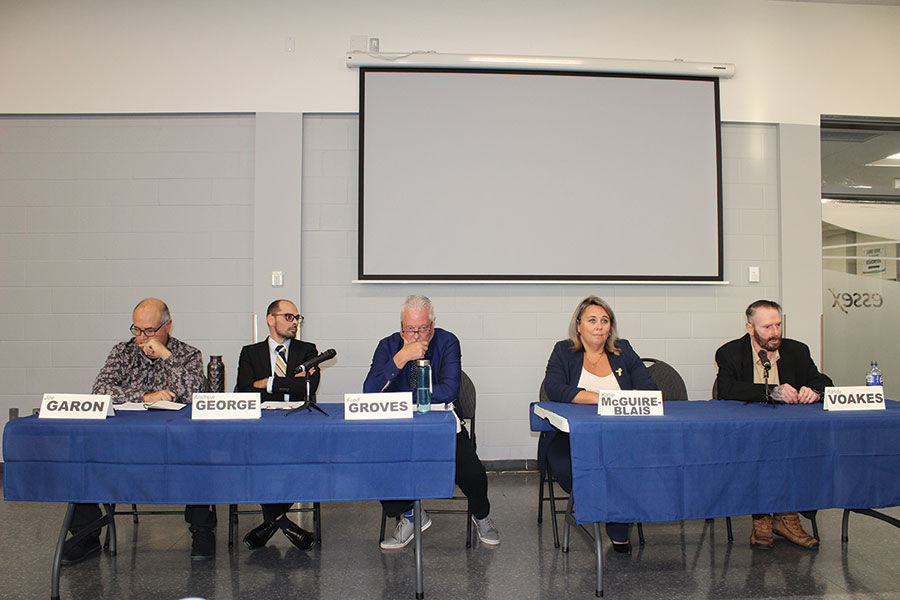
On the evening of Thursday, October 1, candidates running in the Essex Municipal Election for the positions of Mayor or as Councillors for Wards 3 & 4 were able to participate in the Harrow & Colchester South Chamber of Commerce’s Meet the Candidates event.
Here, candidates were able to deliver their campaign messaging, platform priorities, and a little bit about why they believe they are the best fit for the position.
Harrow business owner, Sebastian Schmoranz, moderated the evening, asking an array of questions to the candidates to help the around 60 residents in attendance to determine who they would like to vote for on Election Day.
All the candidates were given an opportunity to introduce themselves first.
Questions to the candidates ranged from growth, flooding, business support, and economic development plans to a vision of fiscal responsibility.
Some of the questions were provided by members of the Harrow & Colchester South Chamber of Commerce, while some were forwarded from the community ahead of the event.
Schmoranz thanked all the candidates who attended the event. He said it is important for members of the community to have an opportunity to hear their ideas and their plans for the future of the community.
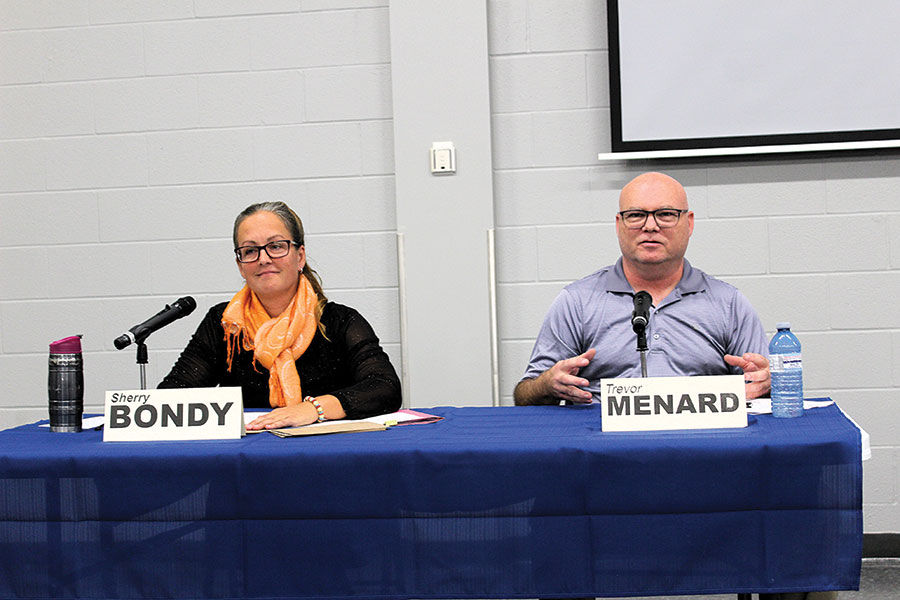
Participating in the event were Mayoral candidates, incumbent Sherry Bondy and challenger Trevor Menard. Ward 3- Colchester candidates Bill Baker, Ron Rogers, Chris Vander Doelen, Kyle LeFaive, Corey St. Onge, and incumbent Jason Matyi took the opportunity to participate. Residents will be able to elect two Ward 3 candidates to Essex council. In addition, Ward 4 – Harrow incumbent Rodney Hammond and Challenger Rachael Mills attended. There is one Ward 4 seat. Candidate Deb Peters was not in attendance.
Ward 4 – Harrow
While introducing himself, incumbent Rodney Hammond said representing the town that raised him has been one of the most gratifying four-years of his life. He feels obligated to continue to fight for better roads, better infrastructure, and fiscal responsibility. He believes his intimate knowledge of Ward 4 makes him the superior candidate to represent the community.
Challenger Rachael Mills believes her experience in customer service, healthcare, and connecting individuals to opportunity will bring a grounded perspective to the decisions that will shape everyday lives for the community and their shared future. Since buying her home in Harrow, she said she has connected more deeply with the community through volunteering with the Chamber and joining the Town's Affordable Housing Task Force.
The first question posed to the Harrow candidates asked what specific actions should the Town take to attract new businesses and encourage investment in Harrow.
Hammond believes Harrow has done a great job rebounding after the loss of the high school. Many businesses catered to the high school students who frequented those businesses. Once the high school was closed, so did some businesses. But they rebounded, and some of the buildings were repurposed for new businesses. Currently, Harrow is not in a position to grow unless houses are starting to be removed. Flooding issues have to be dealt with before growth can continue.
Mills said Harrow has a thriving core and engaged businesses. That was one of the reasons she was proud to join the Chamber. There is a low vacancy rate. Part of this opportunity is balancing vacancy with opportunity. That can be explored when new growth is seen in the core, and commercial development is at the base to bring in mixed-use developments. Ensuring commercial and industrial development is focused in areas that make the most sense, and that those opportunities provide good jobs. For her, that would not include data centers at the scale discussed.
The second question asked the Harrow candidates how they would ensure roads, water, wastewater, drainage, parks and other services keep pace with growth, and what they would do if the necessary infrastructure funding were not available.
Mills spoke of how challenges and opportunities throughout the entire municipality are interconnected. She believes land use planning is something that touches everyone. There is an important opportunity to guide thoughtful and sustainable growth that honours the character, needs, and resilience of the community. Natural heritage, the environment, and farmland have to be at the forefront when planning for growth.
Hammond said that with every new subdivision, there are more exaggerated flooding problems in Harrow. He said there is sufficient infrastructure, but it is not being approved with each additional subdivision. He said the Town needs to get a hold of its infrastructure. He suggests investing in the proper engineering to get a solution. Without that, he can't see any further growth in the community without jeopardizing everyone who has already been there.
Ward 3 – Colchester
Candidate Bill Baker introduced himself as having experience as a Ward 3 Councillor, having served previously. After his unsuccessful mayoral campaign, he continued to remain involved in the community. Over the past 12-years, he has been a member of the Committee of Adjustment, the Affordable Housing Task Force, the Climate Change Adaptation Committee, and the advisory committee for the Colchester Secondary Plan. He said he has lots of experience in the public and private sector.
Kyle Lefaive was raised in the area and attended local Harrow schools. He has worked in quality assurance management, produce, and project management, sales, and engineering in the automotive tier one and two supply sector. Currently, he works as a public works equipment operator for the Municipality of Lakeshore. As someone who fixes the roads, he sees the bureaucratic process as an employee. He wants to take all of his career experience to do as best as he can for the community.
Incumbent Jason Matyi said flooding on his beach is what first got him engaged with municipal politics. He realized what happens when drainage is handled in patches. He works as a Maintenance Manager. He holds a degree in mechatronics engineering and is a licensed tool and die maker. His job is to find the root cause of a problem and fix it properly. He brings that approach to Council. His priorities include drainage and flood protection for beach communities, preserving natural water and heritage space, safer speeds on rural roads, and a fair share of investment for Harrow and Colchester.
Ron Rogers spent more than 30-years at an automotive tier 1 supply company. He started on the ground level and worked his way up to Corporate Sales Director. He spent 12-years on Council in the past. Over those years, he enjoyed his activities and actions with Council. He wishes to continue that now. He believes the community is in a spot where it is going in the right direction and it needs to continue that way.
Corey St. Onge grew up in Essex, went to Holy Name School, moved away from the area a few years ago, and purchased property in Ward 3 in 2019. He wants to get into politics because he has two boys, and he wants to make a better community for them, one they can grow up in and thrive. He is a Project Manager and Developer. He has brought developments from raw land to building hundreds of homes on it. His experience could really help in managing the Town's budget and proper development.
Chris Vander Doelen moved to the area in 1982. He has had a long career in journalism, beginning with covering City Hall and the steel industry in Sault Ste. Marie. When he moved to the area, he realized how much better he liked Essex County. He worked for The Windsor Star for 34-years. He served on Essex Council as a Ward 3 rep for one term, beginning in 2018. He ran because he realized he had a lot of experience in covering City Hall and related issues, like the environment. He said he has deep knowledge and experience, and believes he has exhibited that in his common-sense first term.
The first question asked to the Ward 3 candidates is what should the Town do to help its agricultural, winery, tourism, hospitality, and small rural businesses grow through the year, while also addressing traffic, parking, infrastructure, and land use concerns for residents.
Baker spoke of agriculture being one of Ward 3's economic sectors. In terms of growing businesses in Colchester, a fair balance needs to be looked at in terms of growth and the character of the community. Housing growth in the area is suggested to be anywhere from 500 to 690 homes in some form of development. That is a concern in terms of how fast the area can grow. Some of that growth will help in terms of local business. He noted it needs to be careful around that. The area is more of a boutique community that is wanted to be kept that way.
Lefaive believes hybridization would be a concept to consider. Agricultural, tourism, restaurants, and hospitality sectors need to work together and share a common vision. He spoke to some of the farms and their ability to pivot from strictly agricultural, to agricultural and retail, and production for the tourism industry. That should be encouraged. Doing so does increase traffic, however. He believes Colchester should move from a secondary development to a tertiary one. Reducing the footprint of slated residential development will alleviate some traffic concerns. Through that, he believes more opportunity will naturally occur through natural competition.
Matyi spoke of how this past Term of Council revised the Colchester Secondary Plan and addressed many of those issues. He noted the Town has enough land for residential use to last until 2051. There is no need to require any more farmland for residential purposes. Residents were engaged through the Colchester Secondary Plan. He made sure they were listened to, and their information got back into that plan. One of the things relayed, they don't want tourism to come first. They are looking for a change to put residents first. There's also a desire to ensure infrastructure and services are being kept up, so smart and responsible growth can happen.
Rogers said Ward 3 is an agricultural community, with tourism as a secondary sector. Tourism in Colchester village is being developed and is highly sought after by a number of people. There are lots of visitors to Colchester on a regular basis now. He spoke of how farmland cannot be taken out of production. He said some of the best agricultural land in Ontario is there. That needs to be protected. There will be individuals wanting to visit Colchester, and Colchester should be promoted as an historical area. He said there is tremendous history out there that is being showcased to some degree, but it can be done more.
St. Onge spoke of how Colchester is agricultural first, but tourism is not something that should be shied away from. A tourism tax could be easily implemented, so the people coming to Colchester help pay for things residents need, such as infrastructure and upgrades. Many other municipalities do that in tourism-focused areas, and that helps the people who actually live there. If tourists can pay for a little bit of what the Town needs, that can be passed along to the farmers and individual businesses, which could lead to more businesses and growth in Town to help infrastructure needs.
Vander Doelen said controlling growth will not be a struggle, because there is almost no growth. He said Essex has had the lowest growth of any community in the region in the last five-years in-a-row. One of the reasons is because there's so much opposition to development. And taxes are really high. He said his taxes had doubled at his home over the last 27-years. They have gone up 54% since 2007. Development does not need to be controlled when taxes are going up that fast. If taxes continue at the rate they are, there will not be any development.
The second question for Ward 3 candidates asked what is the most important policy or protection that must be included in the Colchester Secondary Plan, and whether there any type of development they would not support.
Vander Doelen said obviously heavy industry is not wanted there. That is already protected and it won't go there. He said anything dirty is also not wanted there, or anything that runs all night, as it's a retirement community. He wondered what there is to oppose other than that. Tourism is the best thing to put there, which is why the Town has decided to pour millions of dollars into developing Colchester Harbour two-decades ago. A beautiful job was done there, and that is why it's nice, and that is why tourists want to go there.
St. Onge would not support anything industrial or heavy industrial. It makes no sense out there. He is for strategic and proper development, ensuring the community has what it needs. Can Colchester support a condominium? Maybe, he said. While he is not the decider, he has 15-years experience building them and has pretty good insight as to what would work and not. It is experiences like that he can use to very easily help the community. The infrastructure needs to be looked at. Colchester has flooding issues. He believes it's not the new developments causing them. Infrastructure needs to be fixed upstream, which is what is coming down into Colchester and causing the flooding.
Rogers said Colchester is definitely going to be developed. People want to come and live there. It has to be done smartly and not allow massive developments until the infrastructure can keep up with developments. What he would like to see across the town is development for in-filling. In-filling needs to take place before new subdivisions are put in. He believes that subdivisions in Colchester at this time will not work. The roads in and out of Colchester, nor the infrastructure, are available. It is critical that infrastructure keeps up with development and development keeps up with infrastructure.
Matyi said the Official Plan that was done along with the Colchester Secondary Plan highlighted that there is under-serviced industrial land already in Harrow. He believes in leaving it as is and not having any industrial land out in Colchester. There may be some spots for some light industrial that'll help the agricultural sector. The plan also reviewed the Colchester Schoolhouse and Community Hub. This is an awesome Heritage area. It is one of the things the plan recommended the Town keep and support. He definitely supports that. Essex's Official Plan notes that larger developments there should have public consultation. He believes when it comes to Colchester, consultation with the community should be the standard whenever large developments are planned.
Lefaive said the protection comes down to heritage, identity, and the classic existing architecture. That identity is why people go there. That needs to be preserved at all costs. He's not saying “no” to development and he's not saying change the focus from residents to tourism or industry. There has to be a blend. He doesn't want heavy industry or data centers. He also believes greenhouses bring light pollution and heavy traffic with trucks and transportation. The existing infrastructure needs to be preserved and built upon.
Baker said the first thing that has to be realized is that there's a lot of policy coming down from the provincial government that is moving forward, trying to push for new housing. That is good. What's also in there is the character. There are two elements to that: protecting farmland, and there is no measure to identify what community character is by measuring wastewater infrastructure. Infrastructure has to be before development. One of the issues is the wastewater. One of the issues is that Colchester is at a level of capacity he believes, with some of the new developments proposed, it is at about 66% wastewater capacity. There will be a point where it will be determined what the cost for wastewater will be.
Mayoral
Incumbent Sherry Bondy has almost 16-years on Essex Council, 12 of which were as the Harrow rep and the past four as Mayor. She has two degrees, one in social work and the other in education. She worked for Essex County Library for 14-years before becoming Mayor. She said she loves being Mayor. She is a boots-on-the-ground representative and prides herself on being full-time. When she is called, she is there.
Challenger Trevor Menard has been married for 18-years and has two adult children. He is running on service. He was part of the Army Cadets in North Bay, has served on Essex Fire & Rescue for 31-years, spent 10 years with the OPP as an auxiliary member, and has worked for his company for 35-years. It is a Japanese-owned company, so there are a lot of philosophies which employees abide by, such as continuous improvement, task-taking, and moving things forward.
The first question posed to the Mayoral candidates asked what their plan is to attract investment, support existing businesses, and create sustainable local employment across the municipality.
Bondy explained this Term of Council produced a vacancy report every two-years. The one presented a couple of months ago showed vacancy rates and Harrow and Essex Center are trending down. She said that shows major investments made on the streetscapes are working. She gets a lot of compliments on both Harrow and Essex Center. There was also a Community Improvement Plan (CIP) along County Road 50. That money previously invested in the CIP will be brought back into the urban centers, and look at CIPs in the industrial and commercial areas. In addition, a servicing agreement was passed for Inspirational Industrial Park, which is in Ward 2. So, there will be more industrial growth coming. In the 2027 Budget, an industrial CIP will be looked at to specifically target industrial growth. Industrial growth is where the gravy is when it comes to taxes.
Menard said economic development is very important to the municipality. It needs to grow. There is a great streetscape in Harrow and Essex Center. There are some empty vacant lots or buildings. He would hope investment would fit with the community. He doesn't want to turn investment away. Inspiration Industrial Park is a great opportunity for industrial complexes to be developed. He would hope they would employ some of the residents. There is not a lot of transit to get to and from the major cities. So, it would be fantastic if these businesses and industrial places would hire local residents. Residents in Colchester have to go to Amherstburg or Kingsville for shopping. There may be a need for something bigger to sustain growth.
The second question asked the Mayoral candidates what would be their top municipal spending priority, and what service or area of spending they would be prepared to delay, reduce, or reconsider to help fund it.
Menard spoke of how flooding is a major project that needs to be tackled. And wanting to keep taxes low, outside investment is needed from the province or federal government to do that. Growth is needed to keep taxes low. That can't be done by the municipality alone. A large number of community members are retirees on fixed incomes. Inflation is not going away. He believes there's going to be some tough times where the municipality will have to start cutting back on some of its services, because it won't be able to sustain it without tax growth. Tax growth will have to be done in a balanced way, appropriate for what the municipality is facing economically.
Bondy his hearing, affordability is a number one issue. What is also being heard is that road work and flooding are the two top priorities from budget feedback from the community. That is why Bondy said there haven't been great strides made in terms of recreational visions. What has been focused on is core infrastructure this past term. During her first year as mayor, a complete budget reset was done. Each department had to approach Council with exactly what they needed, rather than what they got the year before and adding onto it. The town also has a diversified income strategy now, where other ways are being explored, such as user fees, bringing water billing in-house to save money, and looking at sponsorship and naming rates. You can tighten and save money, rather than just increase taxes.